5 Study Design
This section serves as a reference guide for investigators who are preparing a grant application, designing an ancillary study, or drafting a manuscript using data from The PRIDE Study. Key details include description of PRIDEnet (participant-powered research network), The PRIDE Study’s design, metadata outlining collection timepoints, and the Ancillary Study process that can be customized for your specific research needs. These resources are designed to ensure accurate, consistent representation of The PRIDE Study in all research materials.
5.1 PRIDEnet
Established in 2015, PRIDEnet is an extensive network of LGBTQIA+ community partners in the U.S. This national network of community partners is dedicated to catalyzing LGBTQIA+ community involvement at all stages of health research and is built upon well-established community-engaged research principles. Through relationship building and digital communications activities, PRIDEnet engages thousands of LGBTQIA+ individuals across the country and offers multiple low-threshold opportunities to participate in studies and shape research priorities. This is accomplished through a highly active Participant Advisory Committee and a Community Partner Consortium comprising over 20 health centers and community organizations across the U.S.
5.2 The PRIDE Study
The PRIDE Study is an innovative, community-engaged, longitudinal cohort study of >31,000 LGBTQIA+ adults across the U.S. It began as an iPhone mobile application pilot from 2015 to 2017. The primary goal of this pilot was to gather participant feedback that would later shape the specifications of the digital research platform. This included revising demographic questions to be more participant-centered, reordering survey items to ensure recognition of diverse identities, and adding the ability for participants to edit their profile information as names and identities can change within LGBTQIA+ communities.
In 2017, with the support of PRIDEnet, The PRIDE Study launched the participant platform (pridestudy.org) for community engagement and study recruiment. The study employed diverse recruitment strategies including social media campaigns, digital advertisements, and partnerships with LGBTQIA+ community-based organizations and events. Eligible participants are 18 years of age or older, resided in the U.S. or its territories, self-identify as LGBTQIA+, and are able to read and understand English. All participants provide electronic informed consent prior to enrollment. See Section 5.5 for key references for The PRIDE Study that describe the platform and community engagement methods.
The PRIDE Study utilizes a state-of-the-art web-based research platform that enables robust participant recruitment, cohort management, real-time cohort statistics, survey administration, deployment of ancillary studies to specific cohort segments, and linkage with external health data sources.
At the study’s inception, participants who enrolled in 2017 were asked to complete an annual health questionnaire that included questions about social experiences and mental and physical health outcomes. Annual questionnaires are reviewed each year by The PRIDE Study team to ensure consistency of core demographic, social, and health questions. Questions and response options are updated to meet changing clinical criteria, shifts in terminology, community input, evolving community needs, and emerging research priorities identified by our research team and the Participant Advisory Committee. This is further supplemented by a rotating set of periodic content and topics that allow us to collect data on specific health areas over time while balancing the burden of survey completion.
In 2018, the Annual Questionnaire was administered as two separate surveys in order to reduce overall length: 1) the Core Annual Questionnaire (with the most important health outcomes), followed by 2) the Annual Questionnaire Supplement (which included additional health topics of interest).
In 2019, The PRIDE Study began implementing a comprehensive lifetime questionnaire that captures participants’ health and experiences across their lifespan. Participants enrolling from 2019 onward are first invited to complete the lifetime questionnaire before proceeding to the annual questionnaire for that administration period. Those who enrolled in 2017 and 2018 were asked to complete the lifetime questionnaire when it became available.
The PRIDE Study underwent another modification in 2023 and administered version 2 of the lifetime survey, which revised the survey content by moving specific questions previously found in the annual questionnaire to the lifetime survey. These questions were moved in response to either community feedback or internal assessment that indicated little to no variability in participants’ responses over time.
All participants are invited to complete follow-up annual questionnaires, with each administration period running from May/June/July through May/June/July of the following year (see specific administration dates below). Annual questionnaire years correspond to the year that the questionnaire opened (e.g., Annual Questionnaire 2022 was first administered in June of 2022 and remained open through May of 2023).
5.3 The PRIDE Study Metadata
Codebooks: These are comprehensive PDFs of questions and answer combinations (including logic flows) in The PRIDE Study questionnaire from Qualtrics — an online survey platform used to design, distribute, and collect responses to questionnaires. In The PRIDE Study, Qualtrics was used to administer questionnaires to participants, using branching logic to display relevant questions based on each participant’s demographic characteristics, prior responses, health history, etc.
| Survey Name | Open Date | Close Date | Status | Codebook | Completed Response | Partial Responses | Total Responses |
|---|---|---|---|---|---|---|---|
| Lifetime Health and Experiences Survey | 27 Jun 2019 | 13 Jul 2022 | Closed | Codebook | 11,127 | 875 | 12,002 |
| Lifetime Health and Experiences Survey Ver. 2 | 24 May 2023 | Open | Codebook | ||||
| 2017 Annual Questionnaire | 02 May 2017 | 02 May 2018 | Closed | Codebook | 5,671 | 1,537 | 7,208 |
| 2018 Annual Questionnaire | 05 Jun 2018 | 25 Jun 2019 | Closed | Codebook | 5,457 | 1,876 | 7,333 |
| 2018 Annual Questionnaire Supplement | 05 Jun 2018 | 25 Jun 2019 | Closed | Codebook | 5,125 | 497 | 5,622 |
| 2019 Annual Questionnaire | 01 Jul 2019 | 28 May 2020 | Closed | Codebook | 4,565 | 1,120 | 5,685 |
| 2020 Annual Questionnaire | 08 Jun 2020 | 29 June 2021 | Closed | Codebook | 5,197 | 1,299 | 6,496 |
| 2021 Annual Questionnaire | 26 Jul 2021 | 23 May 2022 | Closed | Codebook | 4,900 | 1,300 | 6,200 |
| 2022 Annual Questionnaire | 06 Jun 2022 | 16 May 2023 | Closed | Codebook | 5,312 | 1,787 | 7,099 |
| 2023 Annual Questionnaire | 25 May 2023 | 20 May 2024 | Closed | Codebook | 6,307 | 1,418 | 7,725 |
| 2024 Annual Questionnaire | 02 Jun 2024 | 24 May 2025 | Closed | Codebook | 5,557 | 1,409 | 6,966 |
| 2025 Annual Questionnaire | 29 May 2025 | 01 Jun 2026 | Closed | Codebook | 4,518 | 1,442 | 5,960 |
| 2026 Annual Questionnaire | 08 Jun 2026 | Open |
To date, >17,000 participants have completed either version 1 or 2 of the lifetime questionnaire. In addition, >16,000 participants have completed at least one annual questionnaire and >11,000 have completed more than 1 annual questionnaire between 2017-2025 administration periods.
5.4 Ancillary Study
Ancillary studies are research investigations conducted in collaboration with The PRIDE Study. The process was developed to encourage research to benefit LGBTQIA+ communities. There are generally 2 types of ancillary studies that can be proposed:
- New (primary) data collection: Collection of new data via questionnaire or other data collection methods (e.g., qualitative interview) to existing study participants.
- Existing (secondary) data analysis: Analysis of existing data from the Annual Questionnaires and/or Lifetime Survey.
All collaborators (internal or external to PRIDE) who are interested in using already collected data from The PRIDE Study or are interested in collecting new data from participants in The PRIDE Study to conduct research focused on LGBTQIA+ populations are required to submit an ancillary study proposal. These proposals are subjected to review from both the Research Advisory Committee and PRIDEnet Participant Advisory Committee as shown in the flowchart below.
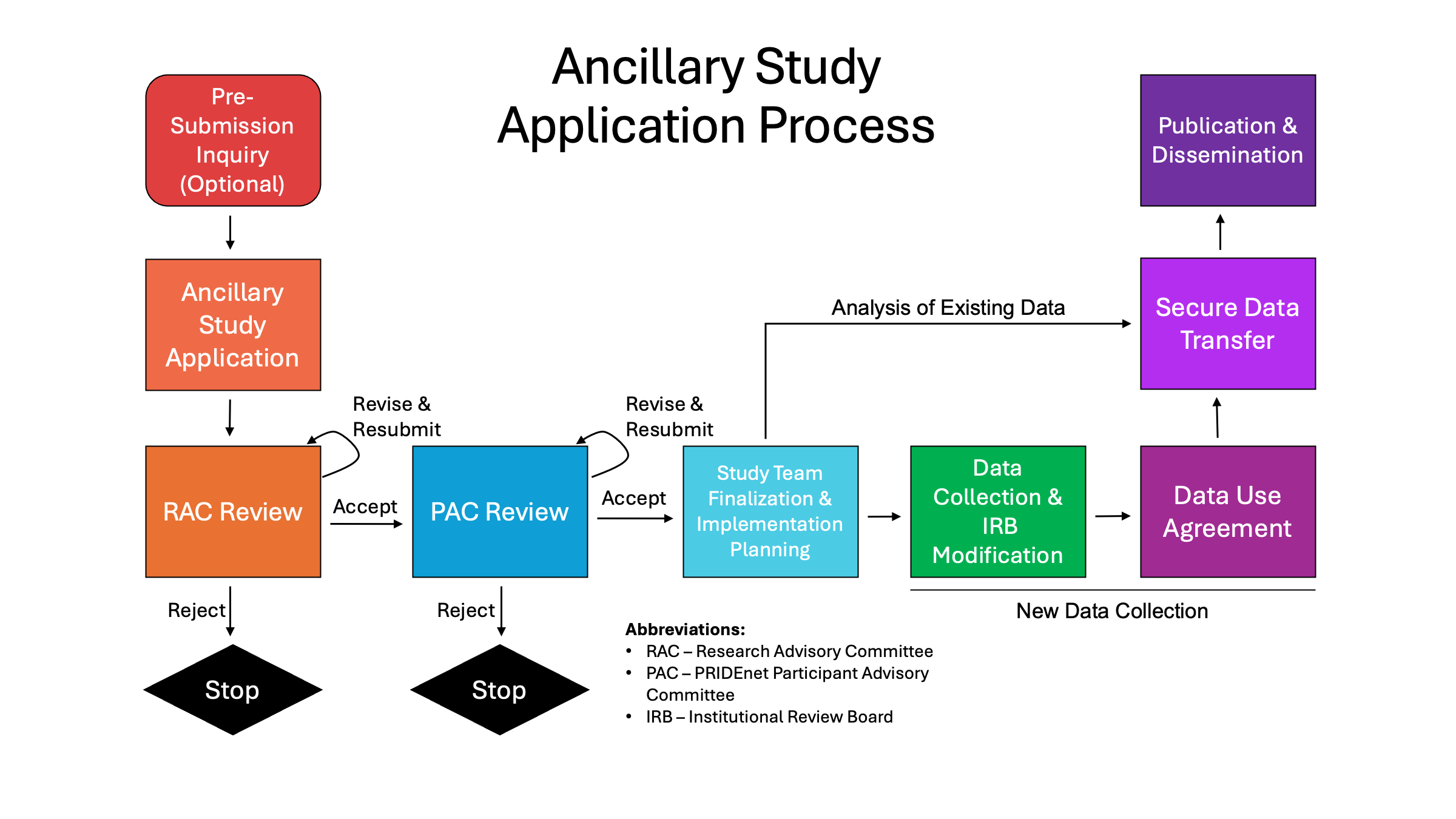
Please visit The PRIDE Study website for information on how to get started with the ancillary study process.
5.4.1 Expedited Review for Students, Trainees, or Early-Stage Researchers
For students, trainees, or early-stage researchers working under the supervision of one of the co-directors, Ancillary Study proposals for secondary data analysis can go through an expedited review process. This generally consists of:
- Completion of a short form Ancillary Study application
- An expedited review by the Research Advisory Committee
- A standard review by the PRIDEnet Participant Advisory Committee
To initiate this process, contact your direct supervisor to request the application document.
5.5 Resources
Lunn MR, Capriotti MR, Flentje A, Bibbins-Domingo K, Pletcher MJ, Triano AJ, Sooksaman C, Frazier J, Obedin-Maliver J. Using mobile technology to engage sexual and gender minorities in clinical research. PLoS One. 2019 May 2;14(5):e0216282. doi: 10.1371/journal.pone.0216282.
Lunn MR, Lubensky M, Hunt C, Flentje A, Capriotti MR, Sooksaman C, Harnett T, Currie D, Neal C, Obedin-Maliver J. A digital health research platform for community engagement, recruitment, and retention of sexual and gender minority adults in a national longitudinal cohort study–The PRIDE Study. J Am Med Inform Assoc. 2019 Aug 1;26(8-9):737-748. doi: 10.1093/jamia/ocz082.
Obedin-Maliver J, Hunt C, Flentje A, Armea-Warren C, Bahati M, Lubensky ME, Dastur Z, Eastburn C, Hundertmark E, Moretti DJ, Pho A, Rescate A, Greene RE, Williams JT, Hursey D, Cook-Daniels L, Lunn MR. Engaging Sexual and Gender Minority (SGM) Communities for Health Research: Building and Sustaining PRIDEnet. J Community Engagem Scholarsh. 2024;16(2):9. doi: 10.54656/jces.v16i2.484.